
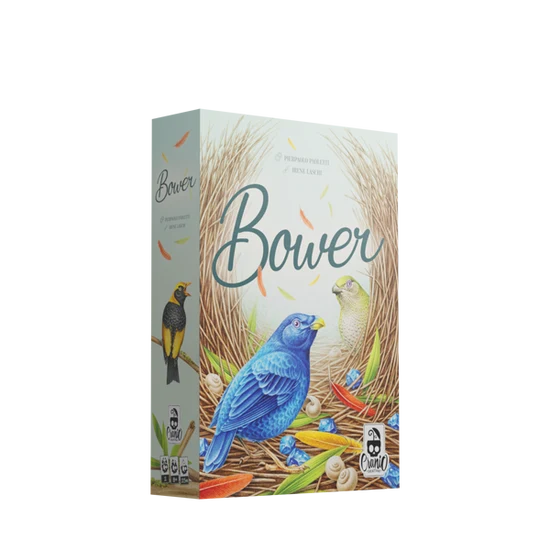
Bower is a compact two-player tile game about building an attractive bower.
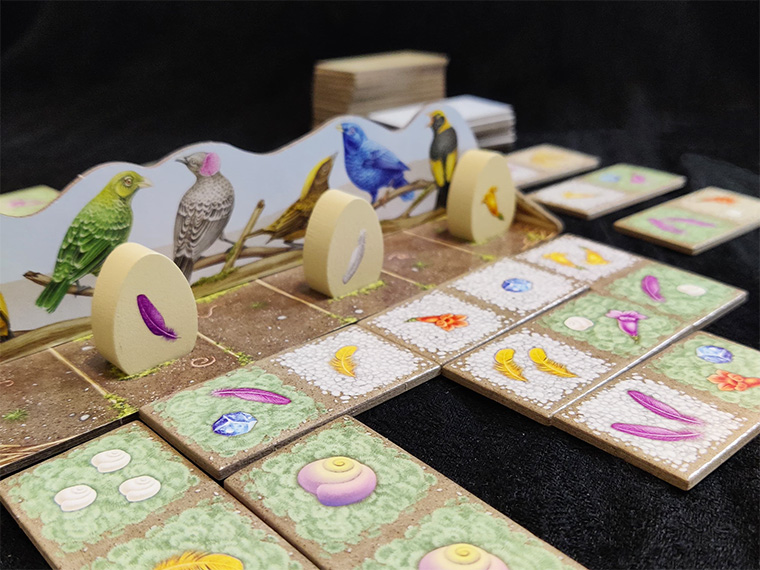
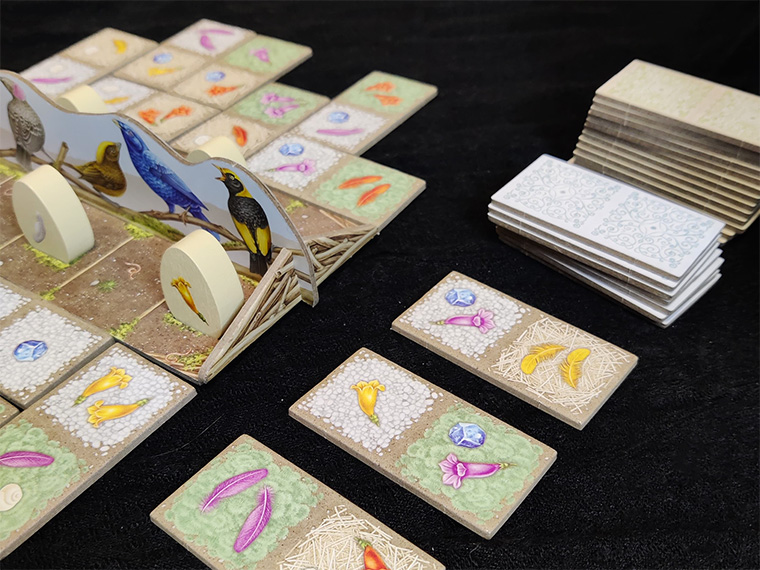
You place domino-like tiles showing feathers, flowers, gems, shells, and nesting materials. However, the real game is a duel over hidden scoring information. Each player knows only half of the six objectives. Meanwhile, both players compete for the largest areas of straw, moss, and gravel.
Theme and Focus
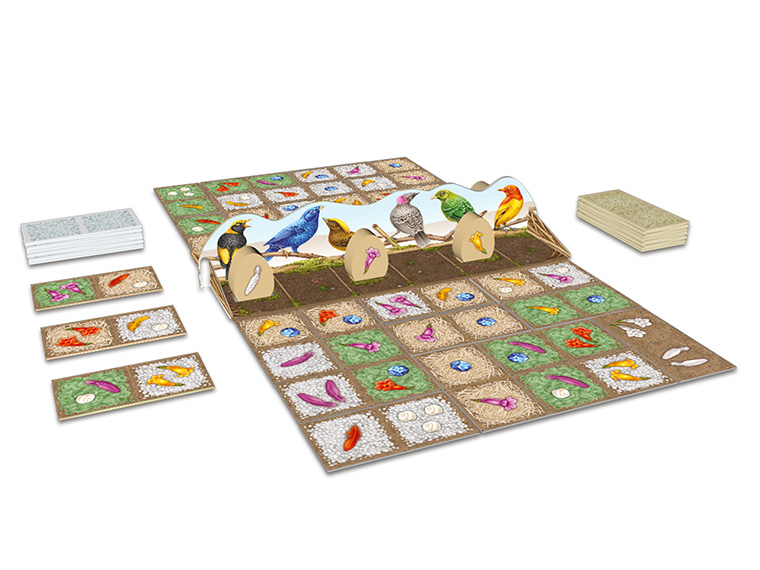
The theme is charming because it mirrors the display-building behavior of bowerbirds. However, Bower never leans heavily into simulation. Instead, it uses that idea to support a tidy spatial puzzle. Each player builds a 6×4 grid over twelve turns. On every turn, you draft one tile and then place one from your hand.
That sounds simple, yet the hidden objectives give every placement extra weight. You may know one column rewards red feathers, while your opponent knows another condition. Therefore, watching their placements becomes almost as important as optimizing your own grid. Meanwhile, gems can unlock bonus tiles that provide tactical advantages.
The result feels more interactive than many modern tile-laying games. However, the deduction never becomes especially deep. Often, good spatial play matters more than reading every hidden objective. Still, the tension between building efficiently and misleading your opponent keeps the game lively.
Pros
- The hidden objectives create strong interaction for such a small game.
- Tile placement stays simple while offering meaningful positional decisions.
- The artwork fits the bird theme well.
- Games are short enough to encourage immediate rematches.
- Multiple scoring pressures prevent the puzzle from feeling one-dimensional.
- The two-player-only design keeps every decision relevant.
Cons
- Some hidden objectives are easier to infer than others.
- Bonus tiles can occasionally feel uneven in value.
- The deduction may disappoint players expecting a heavier mind game.
- Repeated plays can reveal familiar tactical patterns.
- Late spatial mistakes can be difficult to repair.
Comparison to Similar Games
Compared with Patchwork, Bower is less about economic efficiency and more about hidden information. However, both games offer tight two-player spatial competition. Patchwork feels deeper overall, while Bower creates more bluffing and opponent reading.
Compared with Calico, Bower is considerably lighter and less punishing. Meanwhile, both reward careful placement across several overlapping goals. Calico offers the tougher puzzle, while Bower provides stronger head-to-head tension.
Azul also shares Bower’s accessible rules and competitive drafting. However, Azul creates harsher denial through its shared factories. Bower feels gentler, although secret objectives make the interaction less predictable.
Verdict
Overall, Bower is an appealing two-player design with more bite than its peaceful artwork suggests. It combines tile placement, majority scoring, deduction, and bluffing without becoming complicated. However, it remains a light strategy game rather than a deep duel. Experienced players may exhaust its possibilities, yet the short runtime helps. For gaming partners, Bower is clever, attractive, and easy to revisit.