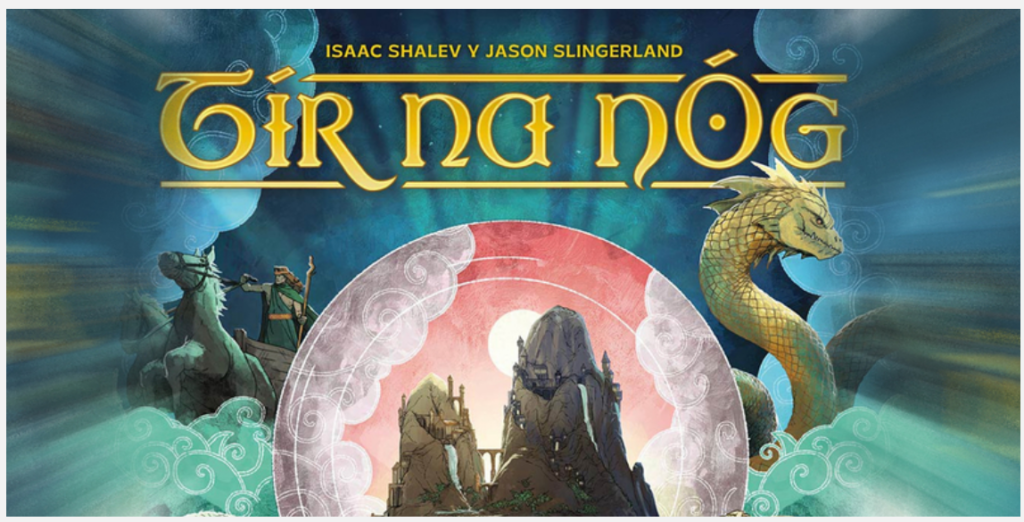
Tír na nÓg is a thoughtful card drafting game wrapped in Celtic folklore.
Players become storytellers journeying through the Otherworld and collecting encounters for personal sagas. However, the theme mainly supports an elegant spatial puzzle rather than a sweeping mythic adventure. Its real focus is drafting efficiently, arranging cards carefully, and reading several scoring systems at once. As an experienced player, I found its restraint more impressive than its initial visual flourish.
Theme and Focus
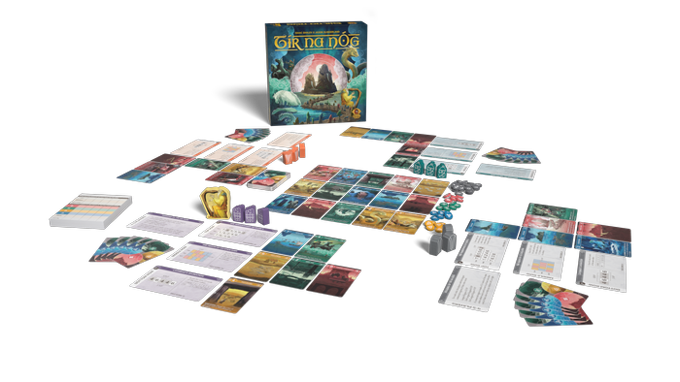
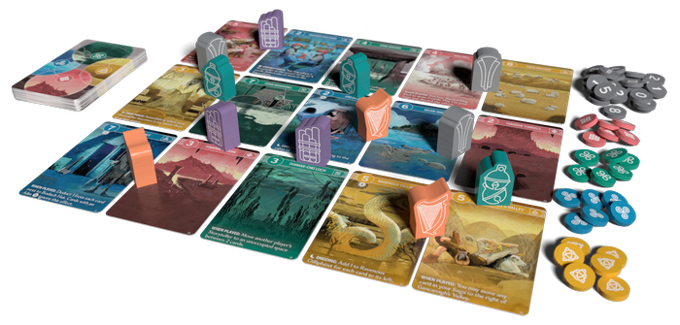
The setting draws upon Tír na nÓg, the legendary Celtic land of youth. Players encounter heroes, creatures, places, and spirits while building stories across three tableau rows. Meanwhile, a shared grid represents the shifting possibilities found during each journey. Storytellers are placed between cards, creating temporary access to two neighboring encounters. After everyone places their storytellers, cards are drafted in reverse placement order.
That reversal creates the game’s sharpest decisions. Placing early offers better positioning, yet later storytellers draft before earlier ones. Therefore, an apparently perfect location can disappear before you claim anything. You must watch opponents, protect essential cards, and accept that some plans will collapse. However, the game never becomes openly confrontational or especially cruel.
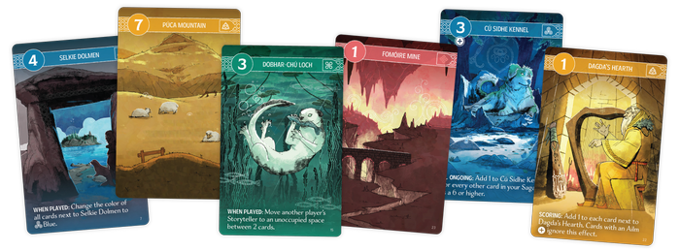
Each drafted card enters your hand, while another card is played into your saga. Consequently, every choice involves both immediate placement and future flexibility. Cards belong to colored regions and carry numbers, symbols, or scoring features. Each tableau row also follows a separate goal card. Because of that, strong turns often improve several objectives without damaging another row.
The theme gives these mechanisms personality, although the connection remains fairly abstract. You are supposedly creating legendary stories, but the final tableau often resembles a mathematical arrangement. Still, the excellent artwork helps each card feel like a genuine encounter. The game feels mystical on the table, even when your decisions remain firmly numerical.
Pros
- The shared drafting grid creates more tension than ordinary open drafting.
- Reverse draft order produces clever timing decisions throughout every round.
- The three scoring rows encourage varied plans without adding excessive rules.
- Hand management gives players flexibility when the available cards become awkward.
- The artwork supports the Celtic atmosphere and makes completed sagas visually satisfying.
- The compact rules create a surprisingly rich puzzle.
- Turns move quickly once everyone understands the scoring cards.
- The changing goals provide meaningful replay value between sessions.
- Players can recover even after opponents claim important cards.
Cons
- The mythology remains decorative rather than deeply integrated.
- Scoring can feel overly mathematical during the final rounds.
- New players may struggle to evaluate several goals simultaneously.
- Some scoring cards are easier to understand than others.
- Accidental blocking can matter as much as deliberate interaction.
- The central grid may create analysis paralysis for cautious players.
- Progress can feel difficult to judge before final scoring.
- The solo mode works, but multiplayer drafting offers the stronger experience.
Comparison to Similar Games
Compared with Arboretum, Tír na nÓg feels gentler and more forgiving. Both games ask players to build numbered arrangements while watching opponents closely. However, Arboretum creates harsher hand tension and much sharper denial. Tír na nÓg instead provides more scoring directions and greater room for recovery.
Compared with Meadow, this game is leaner and more openly competitive. Meadow offers stronger nature storytelling and more relaxed tableau growth. Meanwhile, Tír na nÓg places greater pressure on position, timing, and endgame mathematics. Players wanting atmosphere may prefer Meadow, while puzzle-focused groups may favor Tír na nÓg.
Verdict
Overall, Tír na nÓg is an elegant and rewarding drafting game with striking presentation. However, buyers should expect a scoring puzzle rather than a narrative journey. Its best moments come from manipulating draft order and fitting one card into several plans. Meanwhile, the rotating goals keep its central puzzle from becoming stale too quickly.
I would recommend it most strongly to players who enjoy compact, thoughtful tableau games. However, groups seeking dramatic mythology or direct conflict may find it emotionally distant. The game asks for concentration, yet it rarely becomes exhausting. Ultimately, Tír na nÓg succeeds through clever structure, attractive artwork, and satisfying efficiency. It may not tell unforgettable stories, but it consistently creates interesting decisions.