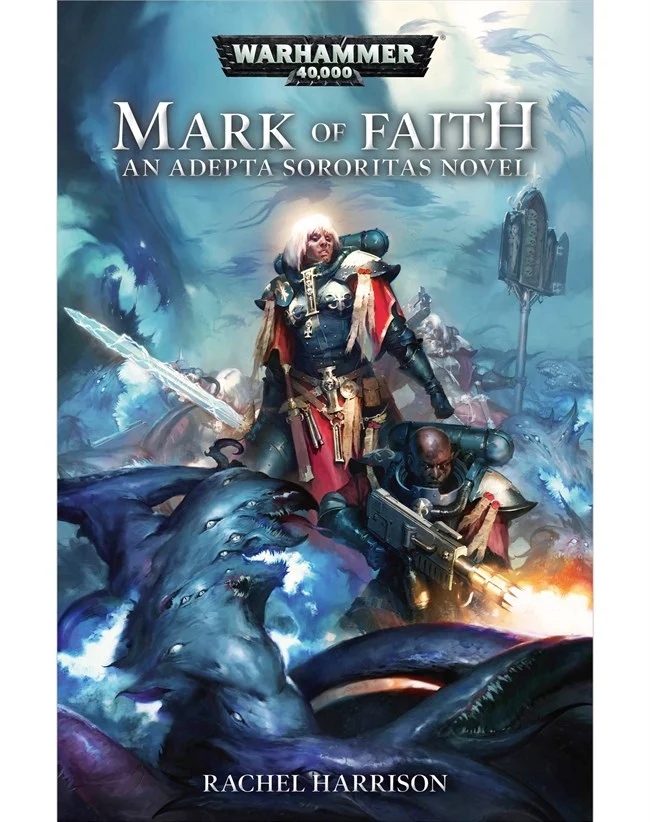
Mark of Faith by Rachel Harrison is one of the stronger Adepta Sororitas novels from modern Black Library.
It is not just “nuns with guns,” although there is plenty of holy fire. Instead, it treats faith as a burden, a weapon, and sometimes a wound. That matters, because Sisters stories can easily become one-note sermons with bolters. However, Harrison gives the book enough doubt, grief, and personal cost to keep it human.
Plot
The story follows Sister Evangeline of the Order of Our Martyred Lady after the devastation of Ophelia VII. She receives a vision-linked mission to recover the Shield of Saint Katherine beyond the Great Rift. Consequently, the novel becomes both pilgrimage and survival story. Evangeline is not simply chasing a relic; she is trying to understand why she survived. Meanwhile, Inquisitor Ravara joins the mission for reasons that are not entirely clean. Her own past and agenda add suspicion to the journey. The plot moves through sacred institutions, warp-haunted travel, and the broken dark of Imperium Nihilus. However, the main villain arrives late and lacks the force the setup deserves. Therefore, the emotional journey lands harder than the final external threat.
Characters
Evangeline is the book’s strongest figure. She is devout, wounded, stubborn, and believable as someone crushed by divine expectation. Harrison writes her faith with respect, but not simplicity. Consequently, her doubts feel like part of devotion rather than a rejection of it. Ravara is more uneven, though still interesting. She brings Inquisitorial paranoia, guilt, and ambition into the story. However, some of her chapters drag compared with Evangeline’s cleaner emotional arc. Still, the contrast works well overall. The Sister believes suffering may have meaning, while Ravara treats meaning as something to interrogate. Their uneasy partnership gives the book its best tension.
Narrative Feel
The novel has a solemn, intimate tone. It is darker than many action-first 40K books, yet it is not joyless. Harrison uses present-tense narration to keep scenes immediate and anxious. Additionally, the alternating viewpoints give the story a confessional quality. The best passages focus on trauma, sacred duty, and the strange horror of being chosen. Action scenes are sharp and readable, but they are not the main attraction. Instead, the book works because it understands how terrifying faith can be. It also captures Imperium Nihilus as more than a map label. This is a region where light feels rare, fragile, and badly needed.
Summary and Verdict
Mark of Faith is a thoughtful, emotionally rich 40K novel with some clear flaws. The antagonist is undercooked, and Ravara’s side of the book is not always as gripping. However, Evangeline’s arc is strong enough to carry the novel. Harrison writes the Sororitas with seriousness, texture, and real sympathy. Consequently, the book stands out as a rewarding read for fans who want faith explored, not merely shouted. It is not perfect, but it is memorable, sincere, and well worth reading.