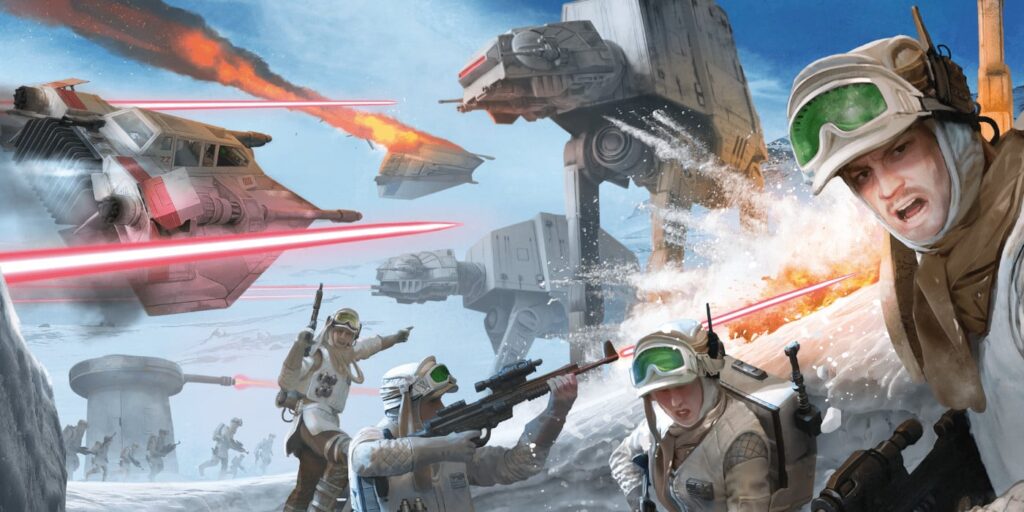
Battle of Hoth by Days of Wonder has been out for a couple weeks now, so let’s take an in-depth look at the game.
Full disclosure, I, like so many others, am a complete sucker for Richard Borg’s Command & Colors system, of which Battle of Hoth is the most recent iteration. These games marvelously combine the spectacle of a miniatures game with the structure and pacing of the best Euro Board Games. They are fun, action packed, fast to learn and fast to play. My 7 and 8 year old boys have played Battle of Hoth every single day since it has arrived with no previous exposure to the Command & Colors system. I spent a single session teaching them to play and they have taken it from there (though I do help with rules clarifications every once in a while). So what is Command & Colors and how does Battle of Hoth fit in?
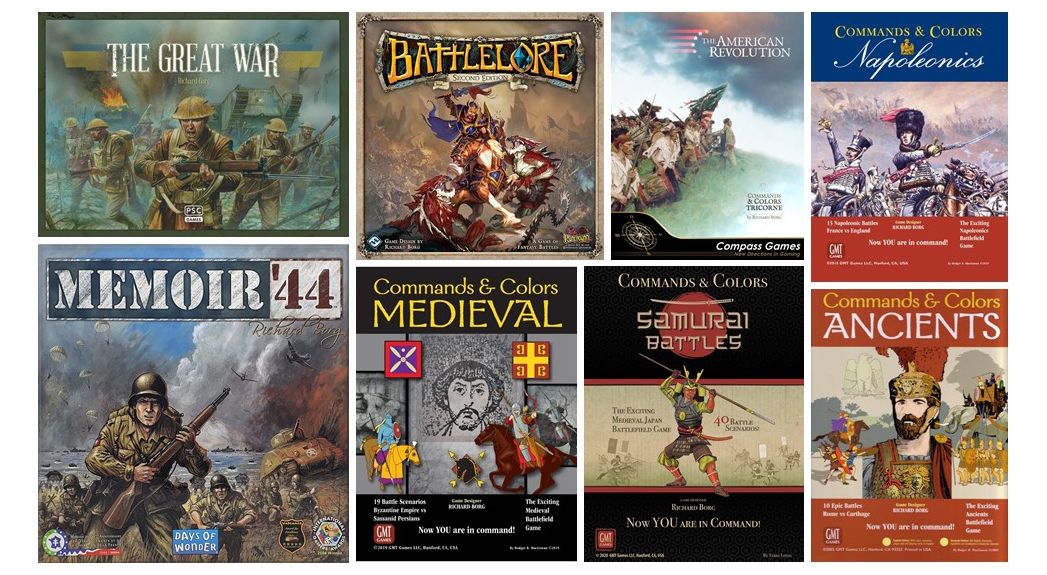
In 2000 Avalon Hill published a Civil War boardgame called Battle Cry that featured a game board covered in hexagons and split into three sections, as well as a load of miniatures. There were cardboard tiles that represented different terrain features, such as hills and woods, as well as cards that players used to activate their units. It was received quite well, and four years later Days of Wonder released Memoir ’44, a WW2 game that used the same system but with new types of command cards to better depict the period. Despite having very similar core mechanics these games played wildly differently and managed to impart some real period specific aesthetics. In 2006 GMT games released Command & Colors: Ancients and the game system had its name. After Ancients came Battlelore, set in a traditional fantasy world with orcs, dwarves and the like, Then Napoleonics, Samurai, Battlelore with a reimagined setting, and many more.
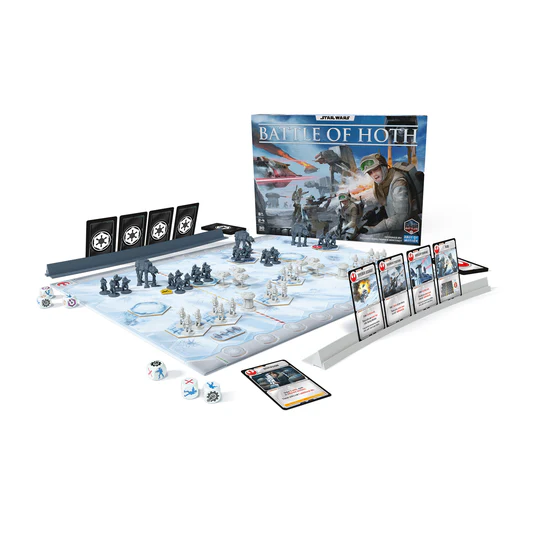
Despite all these games depicting wildly different periods and settings, they all used the same, simple core mechanics, each with some very clever tweaks, and Battle of Hoth is no different. The rulebook is amazingly short and concise, while also very exact and easily understood; one of the benefits of writing nearly the same book a dozen times. The game board is divided into Hexagons overlaid with two lines dividing it into three sections (left, middle and right, for both players). Games are played using pre-designed scenarios which tell players where to place terrain tiles and units. The game comes with 17 scenarios, and one bonus scenario that requires two copies of the game, as well as a mini campaign with linked scenarios. For units, Rebels have access to Echo Base Defenders (Infantry), snow speeders and turrets, while the Empire has Snowtroopers, probe droids and 3 mighty AT-ATs. There are two 16 card activation decks for the factions, as well as three leaders for each faction, depicted by three special cards.
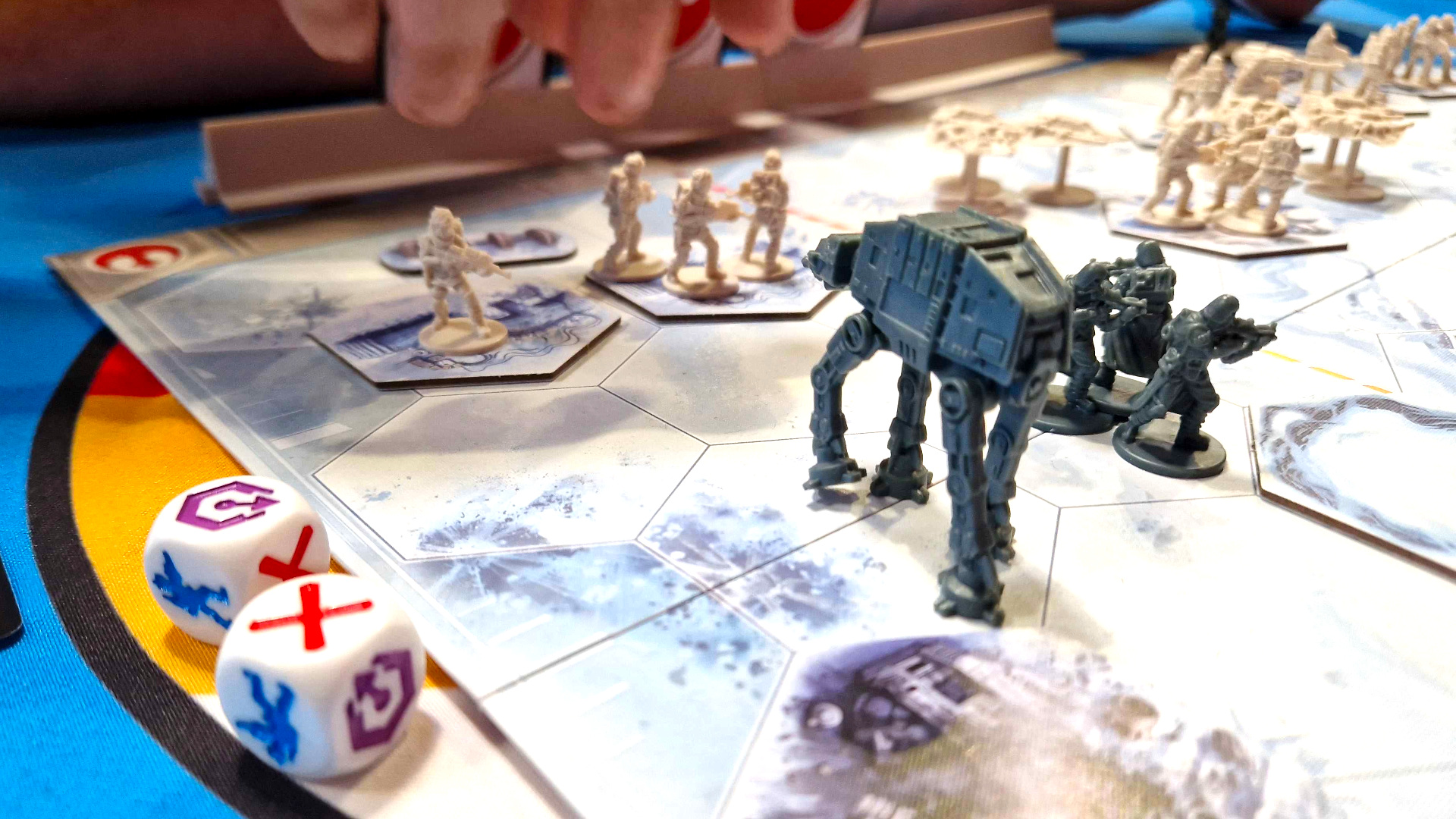
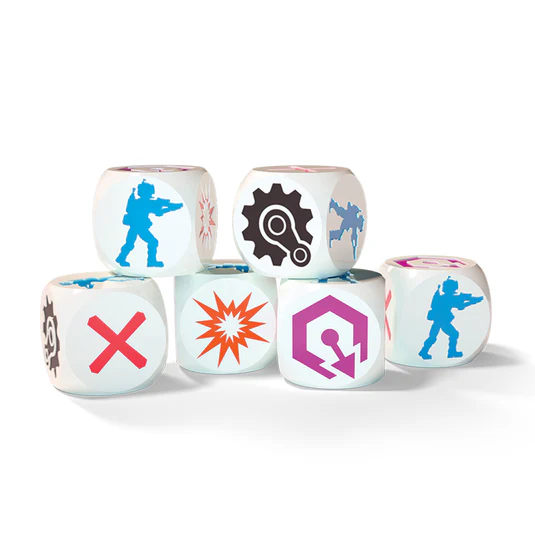
When playing a scenario, players will choose a leader, shuffle that leader’s cards into their deck and then draw the number of cards indicated by the scenario (usually 4 or 5). Players take turn playing cards which allow them to activate units on the board, moving and then shooting with them. Units attack by rolling a number of proprietary D6, the number of which are modified by range and cover. There are handy cheat sheets showing units’ range and power, as well as which symbols affect them when they are being targeted. Certain terrain types will force attackers to roll fewer dice or allow defenders to ignore the first of a given symbol rolled against them. Some units are hit by more than one symbol, others by just one, and AT-ATs require all hits to be rolled again. This is fairly standard stuff for all C&C games. The real flavor comes from the cards.
Command Decks in C&C games are usually broken up into two types of cards: Section Cards and Tactics Cards. Section Cards allow a player to activate some or all of their units in a certain section, while Tactics Cards might activate all units of a given type, or activate a few units but give them special bonuses. Tactics cards vary wildly across C&C games, so it is hard to say what they “usually” do, but they are usually the main contributor to the flavor of the game, apart from the different units and their attributes. For instance, the Imperial player has a card that allows them to activate all of their units, but they all roll one less die during their attack rolls, to simulate the human wave tactics of the Imperial Army. The main strategic element in the game is deciding when to use certain cards in your hand for maximum effect. There is the possibility of being stifled by a bad hand, but this rarely happens, and there is the option to muck your hand in favor of a new one. On the whole, I don’t find myself struggling for strategic options like I have in other C&C games.
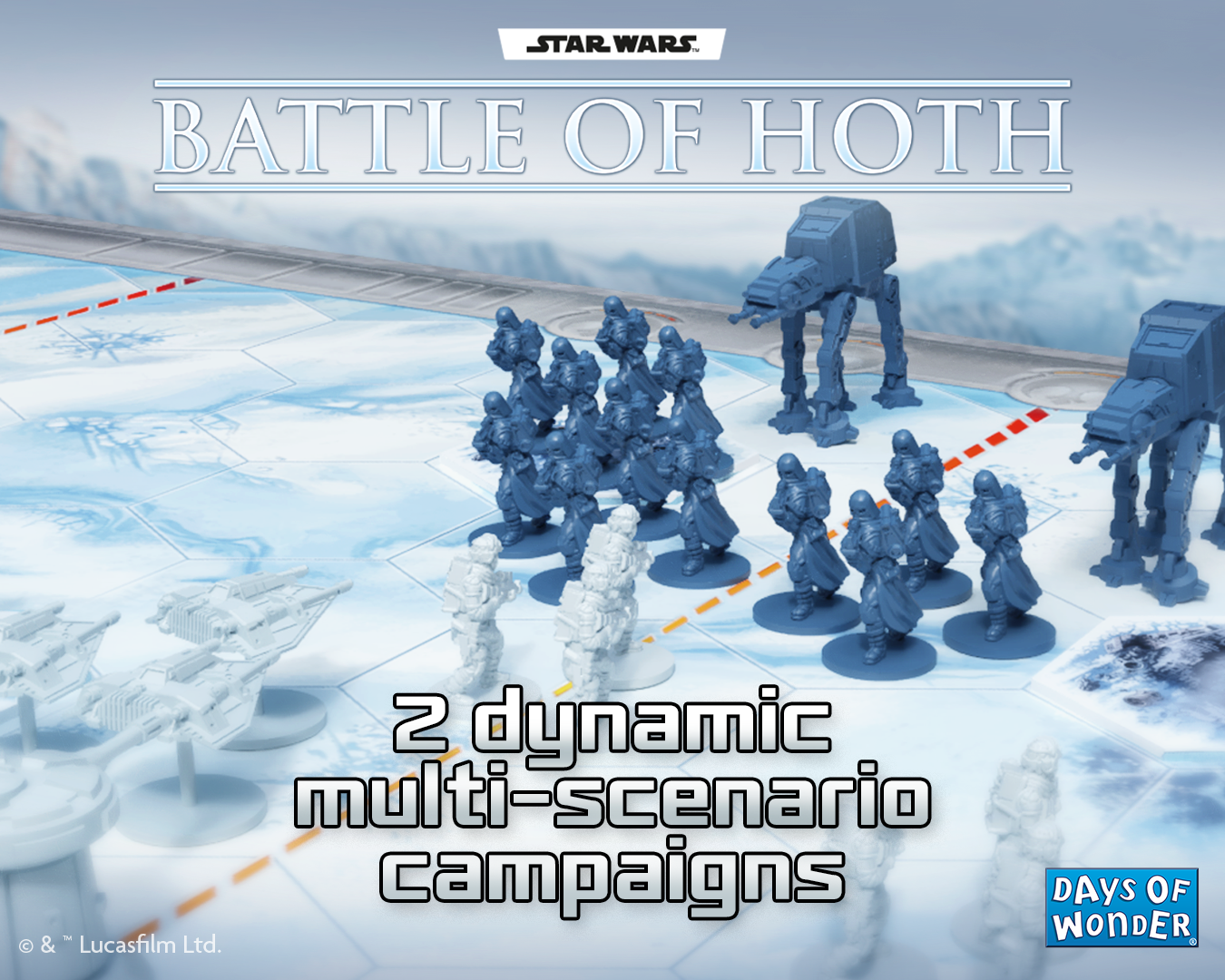
A scenario takes 10-15 minutes to set up and 30-45 minutes to play. There is enough variation in the command decks, especially with the addition of Commander Cards, that there is significant replayability for all scenarios. One of the aspects of the Command & Colors system that I really appreciate is how well it handles different scales of conflict. The board is always the same size for all scenarios, as are the units (three infantry per hex for rebels, four for imperials), but depending on how the terrain is laid out, you might be depicting the Assault on Echo Base as seen in Empire Strikes Back or a collection of squads contesting a hill on one flank of the greater conflict. A hex of troopers might be a squad, platoon or a company, and the game still works and feels great.
On the whole, Battle of Hoth is great. It is a lot of fun, but I do have some critiques. First of all, the game could use a little more unit variety. There are currently no AT-STs or Tauntaun Riders, and unless they are forthcoming as an expansion that feels like a real oversight. True, there are some upgrade options for units, in the form of tokens that represent veterans or special weapons units, but an extra miniature type per side would make the armies feel just a bit more well rounded. Also, units very rarely have any need to work in concert. In other C&C games it can be very important to keep your units adjacent to one another as they will get bonuses for doing so. Those are not present here, making it much more accessible to younger players, but also taking away a degree of strategic depth that I really loved. Still, Battle of Hoth is very enjoyable and I can’t wait to see some lunatic put on a 28mm version of it at a convention, as has been done with so many other C&C games over the years.
What do you think? Will you be picking up a copy of Battle of Hoth for you and your friends? Let us know what you think in the comments!
And remember, Frontline Gaming sells gaming products at a discount, every day in their webcart!