
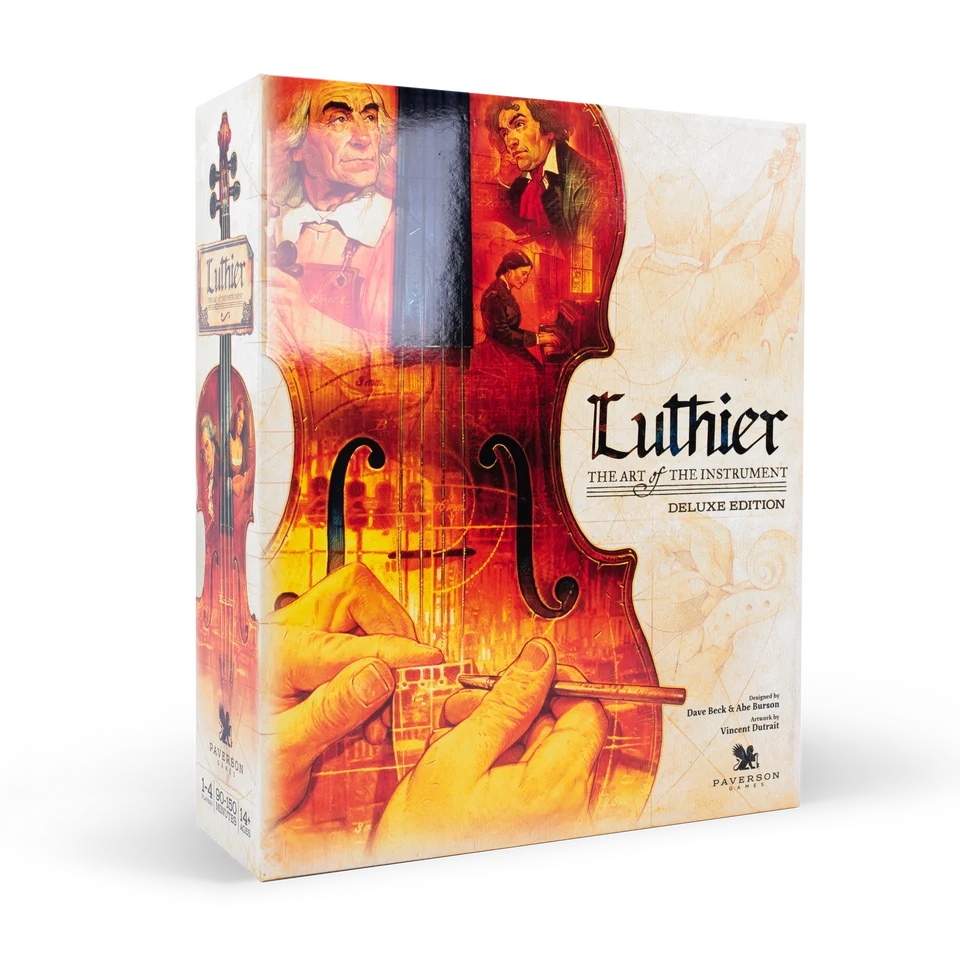
Luthier is a heavy strategy game about crafting instruments during the golden age of classical music.
However, it is not simply another worker placement game with a historical skin. Players manage workshops, court patrons, improve skills, and compete for prestige across six rounds. Meanwhile, hidden bidding determines who gains access to crucial actions. The result feels thematic, interactive, and considerably more confrontational than many modern Euros. You can see more here.
Luthier Theme and Focus Review

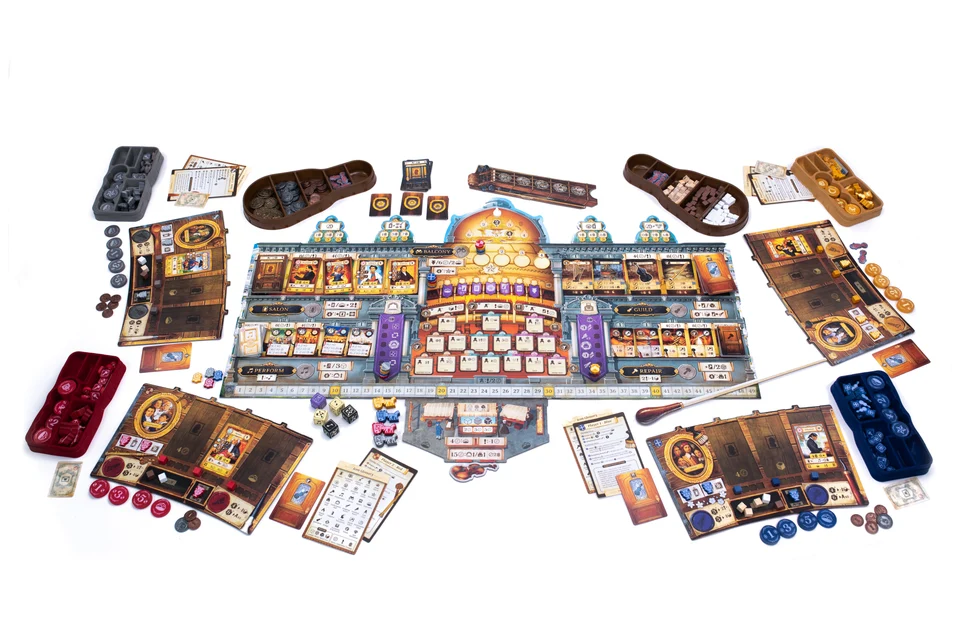
The theme centers on historical instrument makers serving wealthy patrons and famous composers. However, the game focuses equally on reputation and professional development. You can build instruments, repair existing ones, perform music, train apprentices, and expand your workshop. Meanwhile, patrons provide objectives and benefits that encourage different strategies.
The standout mechanism combines worker placement with hidden bids. Players assign workers face down, so rivals rarely know exactly how much strength you committed. Therefore, choosing where to compete becomes a psychological decision rather than simple blocking.
Worker specialization also matters. As skills improve, certain workers become better at particular actions. Consequently, long-term planning rewards players who know which areas they want to dominate. Still, flexible play remains important because contested spaces can disrupt careful plans.
Pros
- Hidden bidding makes worker placement unusually tense and interactive.
- Instrument crafting ties the economic puzzle closely to the theme.
- Historical patrons give different strategies useful direction.
- Multiple scoring routes support varied approaches across repeated plays.
- The artwork and production create an attractive period atmosphere.
- Worker development gives long-term planning a satisfying sense of growth.

Cons
- The first game can feel dense and demanding.
- Resolution takes time when several contested actions require comparison.
- Instrument building can feel stronger than some alternative strategies.
- The game runs long, especially with deliberate players.
- New players may struggle to judge hidden bids effectively.
- Some systems feel procedural during early sessions.
Comparison to Similar Games

Compared with Lorenzo il Magnifico, Luthier feels more interactive and less deterministic. However, Lorenzo offers a tighter and cleaner efficiency puzzle. Luthier instead adds uncertainty through hidden bidding and stronger thematic presentation.
Compared with Darwin’s Journey, both games reward worker specialization and long-term planning. Meanwhile, Darwin’s Journey feels more spatial and exploration-driven. Luthier places greater emphasis on contested actions, patrons, and resource conversion.
The game also recalls Carnegie through its professional development and economic planning. However, Carnegie is more austere and structurally predictable. Luthier feels more dramatic because opponents can interfere with important actions.
Luthier Review: Verdict

Overall, this Luthier review finds a rich and distinctive heavy Euro. However, its length and rules burden will not suit every group. The best moments come from reading opponents, developing specialists, and completing expensive instruments. Meanwhile, the historical setting gives those systems more personality than expected.
Experienced Euro players should find plenty to explore. Still, players wanting streamlined worker placement may prefer something leaner. Luthier succeeds because its unusual bidding system gives familiar Euro mechanisms a memorable identity.