
The best Imperial Agents Crusade forces don’t “level up,” they tighten the noose. This is Part 1 of a three-part series, and it covers the Crusade Rules sections titled Shadow Operations, Vermilion-Level Assets, and Myriad Missions and Perilous Paths.
These are the rules that sit above the battlefield, and they’re the reason Agents feel like Agents in a long campaign. If you’ve ever felt like Crusade can drift into “Matched Play with extra steps,” this section is the cure. It gives you a real operational scoreboard, a ticking clock, and rewards that feel like political pull rather than just bigger numbers.
It also quietly pressures you to bring Characters and play with intent, because the operation literally doesn’t move without them. I love it for narrative nights, but I love it even more because it’s mechanically clear and hard to game without actually playing well. And yes, it absolutely creates those cinematic moments where you win the mission but still feel like you’re losing the sector.
Shadow Operations: the campaign inside the campaign
Shadow Operations start when your Crusade force has any Agents of the Imperium Characters, and you pick a sub-sector that contains three Threats. Each Threat has a Threat Level that sets its Threat Score, how hard it is to uncover, and how long you have before it detonates into a “Fulfilled” disaster. Mechanically, that looks like a tight loop:
- Start clean: Sub-sector Control begins at 0, and you begin with 0 Investigation, 0 Influence, and 0 Intrigue.
- Investigation points are your engine: After each Crusade battle, if your Crusade army included one or more Agents Characters, you gain 1 Investigation point and you must allocate it to a Threat that isn’t resolved.
- Uncovering is a roll-off: You pick a Threat, roll a D6, add +1 per Investigation point you’ve banked into that Threat, and if you meet the Threat’s Covert Level you uncover what it actually is.
- Once uncovered, you pick your approach: Every uncovered Threat has an Influence goal and an Intrigue goal. You earn Influence and Intrigue mainly from Agents agendas, and you allocate those points to uncovered Threats after each game.
- Thwarting is a two-step attempt: You attempt to Thwart using Intrigue first (D6 + Intrigue points vs the Intrigue goal). If you fail, you can then attempt using Influence (D6 + Influence points vs the Influence goal).
- The clock advances every game: After updates, every active Threat ticks its Time Remaining forward, and you roll a Plot Twist that can spike a Threat Score, add time, increase goals, reduce time, or grant extra Investigation.
- If the timer fills, you lose control: When a Threat’s Time Remaining completes, if it’s not Thwarted it becomes Fulfilled, and you lose Sub-sector Control equal to its Threat Score.
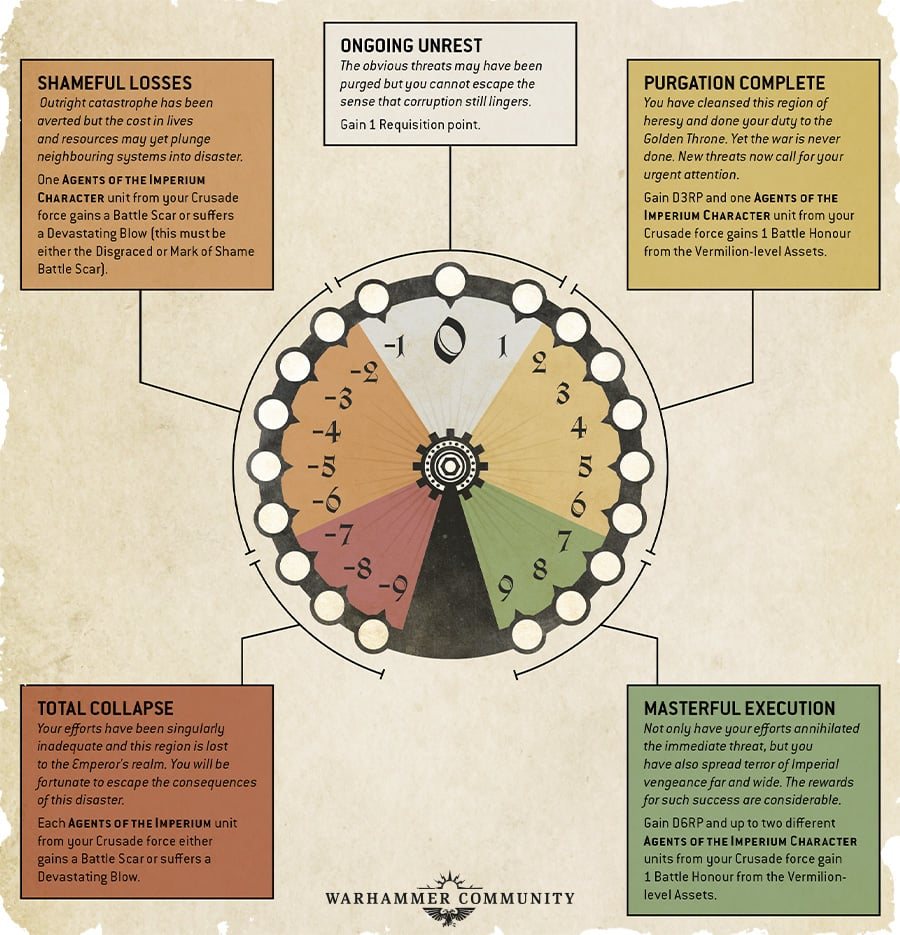
What this does at the table is force you to care about tempo. I’ve seen players “win” three straight missions and still stumble into Shameful Losses because they didn’t prioritize uncovering early, or they spread points across all three Threats and never crossed the finish line on any of them. My personal rule of thumb is simple: you can dabble in three Threats, but you should be trying to finish one as early as possible to stabilize your control track.
Vermilion-Level Assets: unique rewards that feel like real leverage
When your Shadow Operation ends (because all Threats are Thwarted or Fulfilled), you score Sub-sector Control and get consequences. The positive outcomes are where Vermilion-Level Assets come in, and the best part is they’re unique across your whole Crusade force. You can’t spam the same “best pick” on three Characters, which keeps Agents from turning into identical buff-stacks.
A few assets that shape how you build and play:
- Highly Placed Ally: front-loads command pressure (extra command point if they’re your Warlord), and can turn wins into extra Requisition points if the Character survives the game. This is the “steady campaign economy” pick.
- Secret Forces: the “Agents as allied package” booster. If you’re slotting Agents into another Imperium Crusade army, it increases how many Agents units you can include, and it starts each Shadow Operation with a free Influence point. That’s huge if you’re trying to play the operation game without committing your whole roster to it.
- Trained by a Legend: Lone Operative, Infiltrators, and Stealth on the bearer’s unit, plus you start each Shadow Operation with a free Intrigue point. This is the funniest one in practice, because it turns a Character into a backfield nuisance that also fuels your operation.
- Master of Spies: you start each Shadow Operation with an extra Investigation point, and you can re-roll your Plot Twist result. That last bit is quietly disgusting when one bad twist would push a Threat over the edge.
- Bound Entity (Radical only): grants Deep Strike and lets you re-roll a Thwart attempt using Intrigue once per Shadow Operation. It’s a great “I solve problems with secrets and forbidden tools” flag.
- Upholder of the Creed (Puritan only): extra Leadership and Wounds, plus a re-roll on a Thwart attempt using Influence once per Shadow Operation. This is your “I solve problems with authority and the boot” flag.
- Void Trader: increases Supply Limit if the bearer survives, and it also gives you a mid-campaign “respec” by letting you swap out a relic or weapon modification or take a Requisition point instead. This is the asset you pick when you know your campaign is going to take weird turns.
Myriad Missions and Perilous Paths: story prompts that actually connect to your rules
This section is a set of narrative hook tables you can roll or pick from, tied to the type of Character you’re focusing on. The key value is that it pushes you to frame each Shadow Operation like a season of a show, not just a checklist. It also lines up beautifully with the Puritan vs Radical identity that shows up later in battle traits and relics. If you want your group to buy into the theme, this section gives you the “why” for every fight. I’ve used these prompts as quick between-games scenes, and it makes the operation feel like it’s happening in the same universe as the tabletop.
Shadow Operations are the spine of Agents Crusade, and everything else is basically muscle wrapped around that skeleton. I’ve run plenty of Crusades where the faction rules are “nice,” but they don’t change how you plan. These rules absolutely change how you plan, because you’re balancing mission wins against investigation tempo and a clock that doesn’t care about your feelings.
My favorite early combo is leaning into infiltration play so you can control positioning while still feeding your operation economy. Vermilion assets are also some of the best long-form rewards in 10th, because they feel like influence, favors, and blackmail, not just another +1. If you want something fun, try building a stealth-forward Character with Trained by a Legend, then use them as the anchor for backfield Intrigue games all season. If you want something mean, Master of Spies plus an agenda plan that consistently produces Intrigue will make your Shadow Operation feel inevitable. And if your group loves moral drama, start Puritan, flirt with Radical tools, and let the campaign decide what your Inquisitor becomes.
Next time, we’ll get into the stuff that actually generates your Influence, Intrigue, and Investigation tempo: agendas and requisitions.