


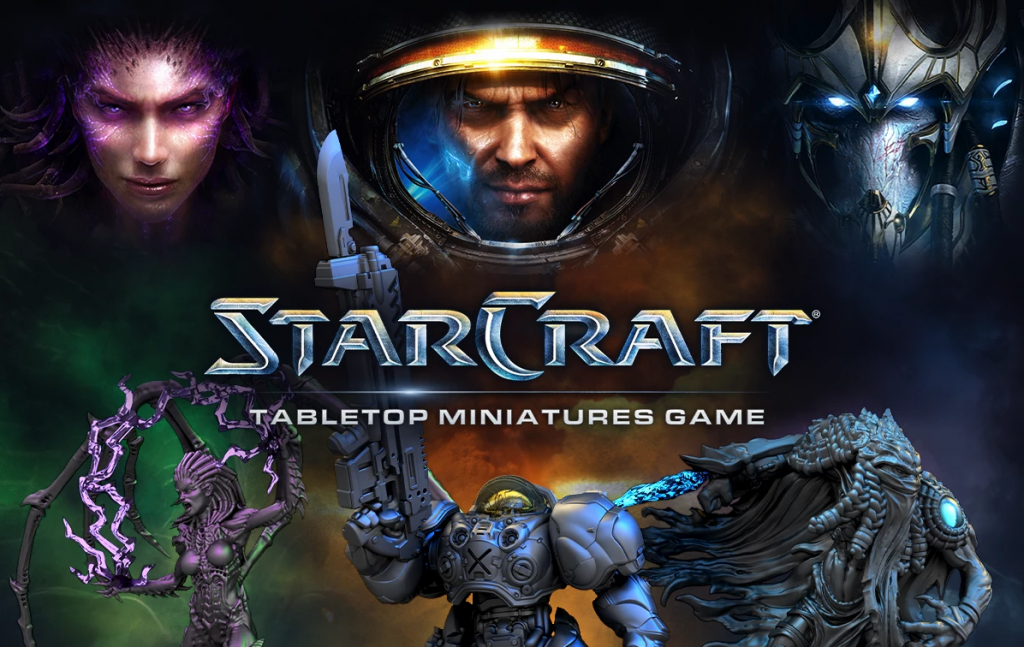
Announced in March 2025, Archon Studios and Blizzard are teaming up to bring the StarCraft IP to the tabletop. First they are releasing a tabletop miniatures game (think Warhammer) in 2026 and then later in 2027 they are planning on board games. I was able to get to play the tabletop game with the rules still in development so lets discuss what StarCraft is and what it can bring to the table.
My background with StarCraft
The original StarCraft video game came out in 1998 with the Brood War expansion following shortly after. My older brother had Starcraft and Brood War, although I never really got into StarCraft 1 and didn’t play on Battle.Net against other gamers. Still, StarCraft made a big impression on the video game scene and in my understanding of real-time strategy games and science fiction settings.
Blizzard was a behemoth in the home PC video game space in the 90’s with hits like WarCraft as a fantasy setting and StarCraft as their science fiction space setting. So much so that StarCraft 1 still has its die-hard fans and a remaster arrived over 20 years after the original.
StarCraft 2: Wings of Liberty came out in 2010 and I was much more involved in gaming to enjoy the strategic and competitive aspects of the game. The original cinematic is still a great experience and encapsulates what feels so visceral and exciting about StarCraft. Check out the Zerg cinematic as well.
I didn’t keep up with the multiple releases of Starcraft 2 but I’ve since casually enjoyed the competitive scene for Starcraft 2, following several content creators and watching competitive games. Even though StarCraft 2 is a ~16 year old game it still has a competitive scene because it has captured the attention of so many people and the gameplay and meta is interesting and dynamic.
Essentially, StarCraft tells the story of the struggle between three factions. The human Terrans use their technology and rugged manifest destiny to expand through the galaxy. The Protoss are a much older race that has developed psionic powers and shields and are individually more powerful. Finally, the primal Zerg are a bug-like race spreading through the galaxy, absorbing biomatter and overrunning any resistance.
Each faction is unique and varied, with strengths and weaknesses, each with an interesting match up with the other factions or in a mirror match. I’ve always been drawn to the Zerg, the fast and swarmy faction, and accordingly have also been drawn to Tyranids in the Warhammer 40K game.
Striking while the iron is hot…
StarCraft is not a new game and the competitive scene is continuing but feels like it is not gaining momentum. This team up between Archon and Blizzard to bring StarCraft to the tabletop doesn’t feel particularly prescient. On the other hand, there are fans of the StarCraft IP from the last ~30 years, many of which are now in the tabletop gaming space. What does StarCraft have to offer tabletop gamers (lots) and should you be excited about getting to play your favorite faction on the tabletop? (yes)
What makes StarCraft great
StarCraft is an exciting game to watch because of several factors. It deals with fog of war and gaining information about your opponent’s progress and army composition as well as trying to deny your opponent that precious information. Scouting and game knowledge are a huge part of the competitive scene. Each faction has strengths and weaknesses and none has an inherent advantage over another, but the tech trees and structures/units you can pivot into can be advantageous.
StarCraft mechanics
In the tabletop game structures and units you can build are locked in during army building so there is not any midgame pivot you can make to try and counter your opponent’s army. I’m sure there will be a developed meta where the best/most popular army can be countered by a build that is designed to take it down. The tabletop game does include Surge dice which interpret those advantages against certain unit tags (Light, Armoured, Biological, etc.) so you can try and set up advantageous unit match-ups.
StarCraft video game also deals in gathering resources, building your base, and growing your army. It can be a game ending attack to wipe out your opponent’s resource gatherers and cripple their economy. The tabletop game automatically grows your resource pool from which you can deploy units onto the tabletop. You will have the option to deploy some units early while keeping others for later Turns, which can also give you strategic decisions on unit matchups. Unfortunately, you won’t be able to obliterate your opponent’s workers in a sneaky run-by with Zerglings.
A typical StarCraft video game can show various strategies, that evolve and develop over the course of the game, from the extremely aggro like sending a bunch of Zerglings and workers as early as possible to try and overwhelm the enemy base, to extremely conservative like Terran turtling in their base until they have late game units they can send across the field. Area and vision control matter a lot, and skirmishes and hit and run battles can be happening throughout the game.
In the video game you also have to juggle the decisions on when to invest in upgrades for your units versus building more units or more buildings. There is a defined tech tree that you’ll need to manage if you want to gain access to new abilities and tactics. The miniature game has to simplify this to designate your army with upgrades before the battle begins, with the pre-defined resources that make up the size of game you are playing.
The tabletop game certainly has the flavor of the factions and units, with lots of nostalgia to pull from. It currently doesn’t represent the real-time strategy that the video game can provide. The miniature game does provide you the ability to craft your very own StarCraft army, ready to deploy with upgrades and a game plan. You’ll come into conflict with your enemy and fight over objectives in a back and forth struggle. You’ll be able to deploy more troops throughout the game in a strategic manner and send them into battle where you think they will be most impactful. I had a lot of fun playing the tabletop game and if this description interests you, I think you will enjoy it as well. If I had to compare it to a current tabletop game I would say it is most like Age of Sigmar system which does appeal to the older and somewhat more casual fans.
My skirmish level game I got to play the Zerg factions which had Queens, Hydralisks, Roaches (Corpsers), and Zerglings at my disposal. I thought it was a very strong list and the Zerg have very strong rules when it comes to their ability to deal damage during their Charge and Hydralisks were an incredibly strong unit when they were able to set up and make ranged attacks into the advancing enemy.
This first taste of the tabletop game, while it was a learning experience more than anything, was a good experience that left me wanting to play it more. I can’t wait to see what the flying units can bring to the tabletop and I already want to field a bunch of tough, fast monsters like the Ultralisks to chew through Marines with ease.
One thing I did notice during the course of our game is the fact that the game has sticky objectives. This means that when you control the objective and start scoring it at the end of every Round, you will continue to score it even if you no longer are standing on it until your opponent comes and takes it over. The real time strategy aspect of the game seems to be the ability to deploy units through the Rounds of the game and only starting Round 1 with a small fraction of your entire army. But if you have lost the objectives it can be difficult to fight your way back onto them and take them back. I’m not sure we got the best example of catch up mechanics in the game and I’m interested in playing more to see if this is a consistent issue.
My opponent was playing the Terran faction, which has a lot of ranged attacks and healing units. However, my Zerg were pretty oppressive with their ability to Charge into his deploying units and my Hydralisks providing great Ranged attacks from the backline. In the video game Terrans definitely are a mobile, ranged attacking army with the ability to get behind enemy lines and harass in places you don’t expect them to pop up in. I’m not sure this identity will translate to the tabletop game yet but I’m hopeful they will get some improvements.
Conclusions
I have a positive outlook for the StarCraft miniature game. The rules and balance of the game are in development and I like what I see so far. I like rolling the big pools of dice and have strategic decisions on what units want to go into my opponent. There will also be Leader or Hero units which can lead an army representing the very powerful and important leaders of the StarCraft universe.
I also think the Protoss faction can be the choice for people looking for a high-skill high-reward type faction. Skill expression may certainly come into play when Protoss have lots of abilities and reactive powers they will have to manage. I think Protoss can be the an opportunity for a skilled player to pilot and a challenge for an opponent to overcome.
I will continue to try and play the StarCraft tabletop game as it progresses and look forward to what Archon studios has to introduce. I think the IP and the foundation of the game is extremely strong so I have high hopes for the future. Let me know what StarCraft unit you want to see represented on the tabletop! As always, you can find me playing Marvel: Crisis Protocol and other tabletop games at the Fabricator’s Forge in Pittsburgh, PA. Check out the Frontline Gaming Store for discounts on minatures. Good luck and happy gaming.