Hey everyone, Reecius here with the next in-depth article for the Hero Expansion: the Paladin. Let’s take a look at the heavy hitter of the Adherents to Zenith!
We’ve previously covered the following classes:
We have previously covered the following classes:
Martial Characters:
- To read the Fighter in depth article, click here.
- To read the Barbarian in depth article, click here.
- To read the Ranger in depth article, click here.
- To read the Rogue in depth article, click here.
- To read the Dark Knight in depth article, click here.
Skill Classes:
- To read the Inquisitor in depth article, click here.
- To read the Warlord in depth article, click here.
- To read the Bard in depth article, click here.
- To read the Alchemist in depth article, click here.
Arcane Classes:
- To read the Shaman in depth article, click here.
- To read the Dread Mage in depth article, click here.
- To read the Priest in depth article, click here.
- To Read the Druid in depth article, click here.

Valiant Warriors of Faith and Steel
The Paladin was a class I was super excited to write. They are one of the most iconic fantasy tropes in gaming and for a good reason. The quintessential knight in shining armor, the good guy that does the right thing and kicks butt. What’s not to like?
For Blood Throne we wanted to create a class that felt true to form but also allowed room to fit into the mythos of the world. Paladins are holy warriors that mix the martial prowess of the Fighter with some of the magical abilities of a Priest. Each is dedicated to the service of a Deh’Va and from their devotion to them gain their supernatural power. Combine this with a platemail clad badass wielding a greatsword and you have quite the combo!

The Power of Faith
Thematically we wanted to capture the idea of the elite holy warrior. Paladins are uncommon, and for good reason. Not only do they have to meet extremely high standards of skill at arms and physical aptitude but also spiritual purity and dedication to an exacting lifestyle free from temptation.
In terms of mechanics and the role the Paladin plays in a party, they are the melee heavy hitter of the Adherents to Zenith faction, the mirror to the Barbarian for the Iconoclasts. However, as you will see, they feel very different to their dark analog. While both want to wade right into the thick of combat and take on as many enemies as possible, the Barbarian focusses on pure rage fueled offense with only a few abilities outside of that narrow scope, taking damage and giving it back. The Paladin in contrast can heal, and is willing (and able via their special rules) to sacrifice themselves to save their comrades or to take out a key enemy.
Equipment Restrictions
Paladins have almost no equipment restrictions beyond not being able to take ranged weapons. They can wear heavy armor (of course, it would be weird if they weren’t able to!) and may wield their choice of sword and board, a great weapon or dual wield. Much like the Dark Knight, you have a wealth of options for how you build out your Paladin, they just have to be made to fight in melee.

Class Ability: No Blow Unanswered
The Paladin’s Class Ability is the core of what makes them a melee powerhouse. Once per Activation, when an opponent hits the Paladin with a melee attack, if able to, the Paladin gets a free attack back! That requires little explanation, you get another chance to smack someone in combat, increase the potential damage a Paladin can do in a game. Lore wise it represents their oath to never allow themselves to receive a blow without striking back, and rules wise it enables them to pump out the DPS. In contrast to the Barbarian that gets to hit another target if they are engaging two, the Paladin reacts. So it is easier to get the Paladin’s extra hit off, but it means you got hit. Pros and cons, and helps to differentiate the two from one another. It also makes a strong argument for giving your Paladin a shield. While the shield reduces your offensive output, it dramatically increases your defensive capabilities so it is a worthwhile consideration.
Primary Skill Tree
The Paladin’s primary skill tree revolves around cracking skulls, and they have a number of abilities to do just that!

Zealous Strike
Zealous Strike is available to choose at level 1, and is a bread and butter ability. It is a straight melee buff, giving the Paladin +1 Accuracy and +1 RD to a melee attack. Simple and highly effective, hit more often and harder! You can enhance this ability with two feats: Mighty Zealous Strike increases the skill to +2 Accuracy and +2 RD damage. Burning Zeal then also means the Paladin sets the target of Zealous Strike on fire! Just an all around fantastic Class Skill which means the Paladin is highly likely to connect and deal devastating damage when they need it.

Vow of Justice Delivered
The Paladin has several Shout Action options which as with other classes are a Simple Action, meaning they do not take away from your core ability to move and punch. Thematically they represent the paladin making a scared promise to accomplish a deed, and using their faith to achieve it despite any odds. This Vow, available at level 4, is a short range shout targeting Will which if successful, allows the paladin to re-roll explosion results when attacking the afflicted model. As a quick reminder, when rolling damage explosion results are 0 damage. This pairs obviously with their core function of kicking butt, enabling the Paladin to lay low their foes.

Righteous Immolation
At level 8 the Paladin gains Righteous Immolation, which is a Casting Action in a short ranged Aura, ignoring LoS, and is once per game. The Paladin takes 3 RD damage and all opposing models take the same amount of damage. What makes this so good is that it automatically hits! That is a solid trade off for the Paladin taking damage, and it hits models the Paladin cannot see. Additionally, the Paladin for one turn will deal 2 RD damage to any model that hits it with a melee attack. This ability is great for running into a cluster of enemies and dealing a ton of damage with no roll required. Particularly in PvE adventures, where monsters will then attack you, you can passively take a bunch of them out! In PvP it means your opponent will likely not attack the Paladin unless they are confident they can finish them off.

Shining Champion
At level 10 the Paladin unlocks their ultimate skill: Shining Champion, a once per game ability. This is a brutally powerful ability, allowing for one turn the Paladin to replace all Damage Dice with Raw Dice! This differs from other similar abilities in that most are one attack, the paladin’s is for one turn. This means if you are in a position to attack twice, you will devastate whatever you hit. Often, outside of boss monsters, it is a kill shot.
Secondary Skill Tree
The Paladin’s secondary skill tree revolves around tanking damage, but with a twist. The Paladin is one of the few classes in the game that can take a hit for an ally, very thematic for these zealous warriors!

Valiant Defender
At level 1 the Paladin may select Valiant Defender, which is a Reactive Action allowing them to change the target of an action from an ally within Reach Range of the Paladin, to themself. This is incredibly useful to avoid one of your Party Members from either getting knocked out or taking an attack or effect they absolutely do not want. For example, if one of your magic users is about to get Silenced, dropping their Metaphysics to 0, if the paladin intercepts that it is much less debilitating for them. Or, an attack that would deal a lot of damage to an ally, that merely tickles the heavily armored Paladin, etc. And as always, Reactive Actions are basically free extra actions so are always useful from an action economy perspective.

Vow of Courage
At level 2 the Paladin may select a simple but very useful skill to give themself a +3 boost to Will for a turn. As this is a Simple Action, it is a great one to have on hand. As Martial classes often are vulnerable to attacks that target Will, this is a fantastic way to bolster that defense and prevent your Paladin from getting paralyzed, Charmed, etc.

Divine Fortitude
At level 6 the Paladin gains a once per game ability to both heal themself for 3 Raw Dice and also to remove all Curses and Afflictions from themself. This is massively useful as some Curses (game long debuffs) can really be debilitating. If you are debuffed into uselessness, pop this card and be rejuvenated! Often simply having it in your deck can be enough to discourage an opponent from debuffing the Paladin at all.
Tertiary Skill Tree
Finally, the Paladin’s tertiary skill tree is healing. While they only have 1 ability, it is extremely useful.

Lay on Hands
At level 1 you gain access to the quintessential Paladin ability: Lay on Hands. This is a reach range healing ability which heals the target (and yes, the Paladin can heal themself) for 2 Raw Dice + Power HP. This can be upgraded with two feats, Reaching Hands increases the skill to Short Range and adds +1 Raw Dice to the healing pool, and Righteous Hands means the target also gains the Rejuvenate HoT, meaning them will heal an additional 3 Raw Dice of HP over time. As it is a Casting Action, the Paladin can use Mobile Casting, meaning they move and then use it, with a chance of failure, but means they do not sacrifice mobility. This does mean it can trigger Attacks of Opportunity though so be mindful, although that can further potentially trigger your No Blow Unanswered! Chain attack! An all around great ability and if you invest the feats into increasing the efficacy, means they have a healing ability that is extremely potent. If nothing else, they can use it on themself to stay in the fight longer. This means the Paladin is a great choice for the Warlord’s Haste buff (or any source of Haste) as with the extra action they can punch twice and heal themself.

Feats
The Paladin’s feats run along two general themes: hitting harder and behind harder to take out. In keeping with the theme of a holy warrior that is part knight and part priest, the Paladin has some very useful feats to select from. As a refresher, all classes select General Feats at odd levels, and class specific feats at even levels apart from level 10 where all classes get their Ultimate skill. Feat choices are permanent and you may only select one of the options apart from level 1 at character creation when you select two.

At level 2, the Paladin may select Divine Purpose to very simply give themself a nice HP boost of +4, or take Faithful Bulwark which allows them to give their fellow party members cover if they are within one square of the Paladin. Cover gives +1 Damage Reduction. In play testing, as with the Barbarian, we found that all out offensively built Paladins needed a bit more HP to ensure you could get them stuck in, so we have the same feat for both classes here to help make them a bit beefier if you have your Paladin with a great weapon or dual wielding. Faithful Bulwark on the other hand is great for a sword and board Paladin that doesn’t need as much HP due to having a shield to reduce damage. This lets them instead make their nearby allies more durable. Heavy martial characters often find themselves with other party members nearby as they tend to push up the middle of the board, so this upgrade comes in handy quite often.
At level 4 the Paladin may select Reaching Hands or Mighty Zealous Strike. These are both very good and it is a tough choice. Reaching Hands increases the range and amount of healing Lay on Hands does where Mighty Zealous Strike increases the power and accuracy of the Paladin’s main offensive skill. Again, it largely comes down to what you want your Paladin doing. If you built yours like I built my own custom Paladin with a badass two handed hammer, you want to focus on doing more damage. However, if your Paladin is more of a tank, then being able to increase the efficacy of the Paladin’s healing means not only are they going to last longer, they can act as a secondary Priest as well.

At level 6 the Paladin can take protection of Faith which increases the Damage Reduction of the paladin by +1 or make Burning Zeal also set the target on fire! Going up to potentially Damage Reduction 4 is very, very good. You take so many dice out of the damage pool that it allows the Paladin to shrug off most attacks. Setting an enemy on fire with your big attack is not only just cool, it adds 3RD damage over time which ratchets up the damage the Paladin does, significantly. As Zealous Strike is also very accurate, you can be tossing DoTs out every turn reliably. As above, it just comes down to what you think you need, to be even more durable or do even more damage. Both really good options.
At level 8 the paladin may select Righteous Hands or Return All Blows. Adding the Rejuvenate HoT (Heal Over Time) to Lay on Hands makes it extremely potent, with both upgrades Lay on Hands is actually a better heal than any other class in the game outside of the Priest. It makes the Paladin a true heal bot, healing a total of 6 RD HP + Power. Being able to reactively hit opponents that hit you twice, likewise, is great. Particularly in boss monster fights, it turns the Paladin into an absolute DPS machine.

Playing Saabir
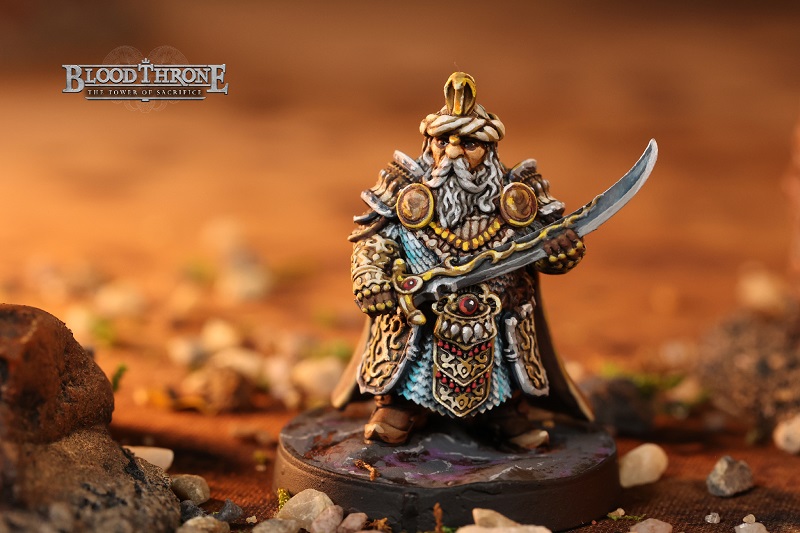
Saabir was a really fun hero to write. He comes from the Arabian Nights inspired faction, Kushna, which we had a blast writing. He is a Desert Dwarf, and the last living Paladin of the Order of the Zaied Habbak. Kushna was devastated during the Throne Wars and their magnificent capital city, Ira’Bar, was destroyed. As such, Saabir is on a quest for vengeance and to try and find some way to restore his faltering people. He is a serious character, and an absolute menace on the tabletop. Plus I just love the model and art for him, such a cool looking character.

Mechanically, Saabir is a brick. He has heavy armor and 21 HP, making him quite sturdy, although without a shield he can get taken out and his Evasion is a very low 2, so do not assume he is invulnerable. A solid defensive buff on him such as Stoneskin or Ironskin from the Transumter goes miles. His other shortcoming (get it, he’s a Dwarf! Yuck yuck!) is his slower speed of 4. So you want to make sure to position him well during deployment in order to not waste time walking around the board doing nothing because, as we will soon see, he hits like an absolute truck. At level 3, the Long Stride General Feat is a great choice to bump him to movement 5.
His Accuracy is 3, which isn’t super high, but his Shamshir has the Accurate keyword which makes it more likely to hit, and with Zealous Strike he gets +1 Accuracy so he is more likely to connect than he may at first appear. Plus, as with almost all great weapons, it has Reach, increasing his range. And when he hits, he delivers the DPS! His Shamshir (rules wise is a greatsword) deals 6 DD but with the Two-Hander feat it goes up to 7 DD which is huge. He also gets the Defensive Keyword from that Feat which lets him Parry once Per Activation without gaining the Disarmed keyword to help reduce damage from at least one attack. Unlike Kijo though, who only has a fist in her Off-Hand, due to having the Mule level 1 Feat which gives him additional point of Encumbrance in addition to ignoring the movement penalty from Heavy Armor, he also has a Dagger. While it may seem weird to have two melee weapons, what it does is let him Parry again with his Dagger so he effectively gets two free Parry actions without sacrificing his offense. This really helps to shore up his defense once he is stuck in. It also means if he cannot use his Main-Hand weapon due to a debuff, he still can stick you with his dagger!
Saabir has Power 3, so with a normal attack he is rolling 10 dice which is brutal. At level 5 you can boost his Might to 4, maxing it, for even more damage! He has solid Fortitude and Will of 3 to protect him from special attacks and can bump his Will to a whopping 6 if you take the Vow of Courage skill. Speaking of which, Saabir only comes with 2 Class Skill choices to begin, so look for any ways to increase his options so you don’t feel starved for choices.

The Heritage Skill of Desert Dwarves is extremely useful. Due to their harsh lives in the desert, they have become extremely resilient. Once per game, as a reactive action, you can remove a Status Effect. Why this is so good as it happens immediately, so as soon as you are hit with an Affliction or Curse, you play the card and just remove it. In PvP this means often you won’t be targeted by a curse as it will be a waste. This really helps Saabir avoid being smacked with a debilitating debuff.
Saabir is fairly straightforward to play. Line him directly up with the enemy and go right into them! Smack the daylights out of them with Zealous Strike, hit them back when they hit you, and just focus on keeping him on the board. As stated, a solid defensive buff is extremely useful for him, or Feather Armor from the Transmuter which will bump him to Movement 5, is another massively beneficial buff.
The biggest challenge to Saabir is just delivering him into combat before he gets blasted at range. As he has no active defense against ranged attacks, that is your biggest weakness, he just relies on his armor to keep him going. Lay on Hands helps a ton to heal himself as he goes, but plan how you will get him into the fight and once there, he is absolutely devastating in melee.
Playing Against Saabir
Saabir is a scary hero to see across from you. He hits so hard he can knock out most heroes in one activation outside of other tanks. As stated above though, he is vulnerable to ranged attacks. The Sorcerer and the Alchemist are fantastic for dealing with these types of Heroes as they have a lot of ways to ignore armor, hit from range and are very accurate. Putting DoTs on him is great to try and get him to use his Heritage skill early, then slap a strong curse on him such as Blind so that his Accuracy goes to 0, making him much less of a threat. Leaden Boots from the Shaman is another great choice as dropping him to movement 3 is brutal.
While tough, he is not invincible and if you can get into him with Kijo, she can take him out due to how hard she hits. Just have a plan for getting around his reactive attack either by denying it with a hero like the Inquisitor, or attacking him in the rear arc so he cannot use his ability. If you simply want to contain him, the Dark Knight is tough enough to just take the beating and hold him up while chipping away at him over time.
Thanks for reading! I hope you are excited to play the Paladin. Next time we will take a dive into the Warlock, the last Martial hero for the Iconoclasts and one of the most fun heroes to play.