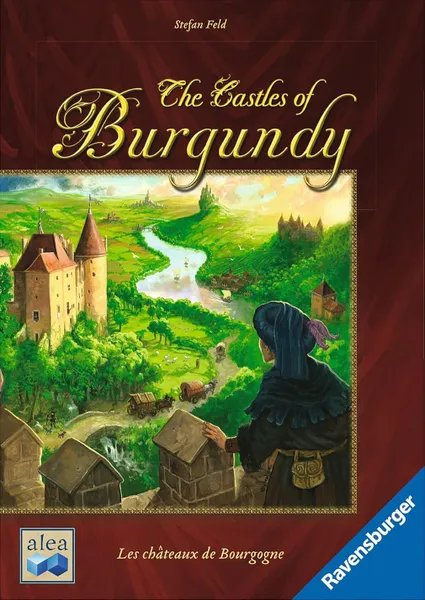
Castles of Burgundy casts players as nobles in medieval Burgundy who develop their princedom via tile placement, trade, and strategic actions.
Each turn, two dice determine which numbered spots you can use, and then you choose between taking a tile, placing a tile, selling goods, or hiring workers. Because of modular setup and varied player boards, each game feels fresh even after many plays. Moreover, the interplay between dice manipulation (via workers) and decision flexibility is central. While the theme is light, it provides just enough narrative to support the mechanical elegance. As a result, the game becomes a satisfying exercise in optimization rather than thematic immersion.
Pros
- Deep strategic choices emerge from simple core rules
- Dice-rolling plus adjustment gives both luck and control
- Modular setup and varied boards enhance replayability
- Turns are quick once familiar, reducing downtime
- Multiple scoring paths allow different strategies
- Good scaling works well at 2–4 players
- The Special Edition improves component quality and aesthetic appeal
Cons
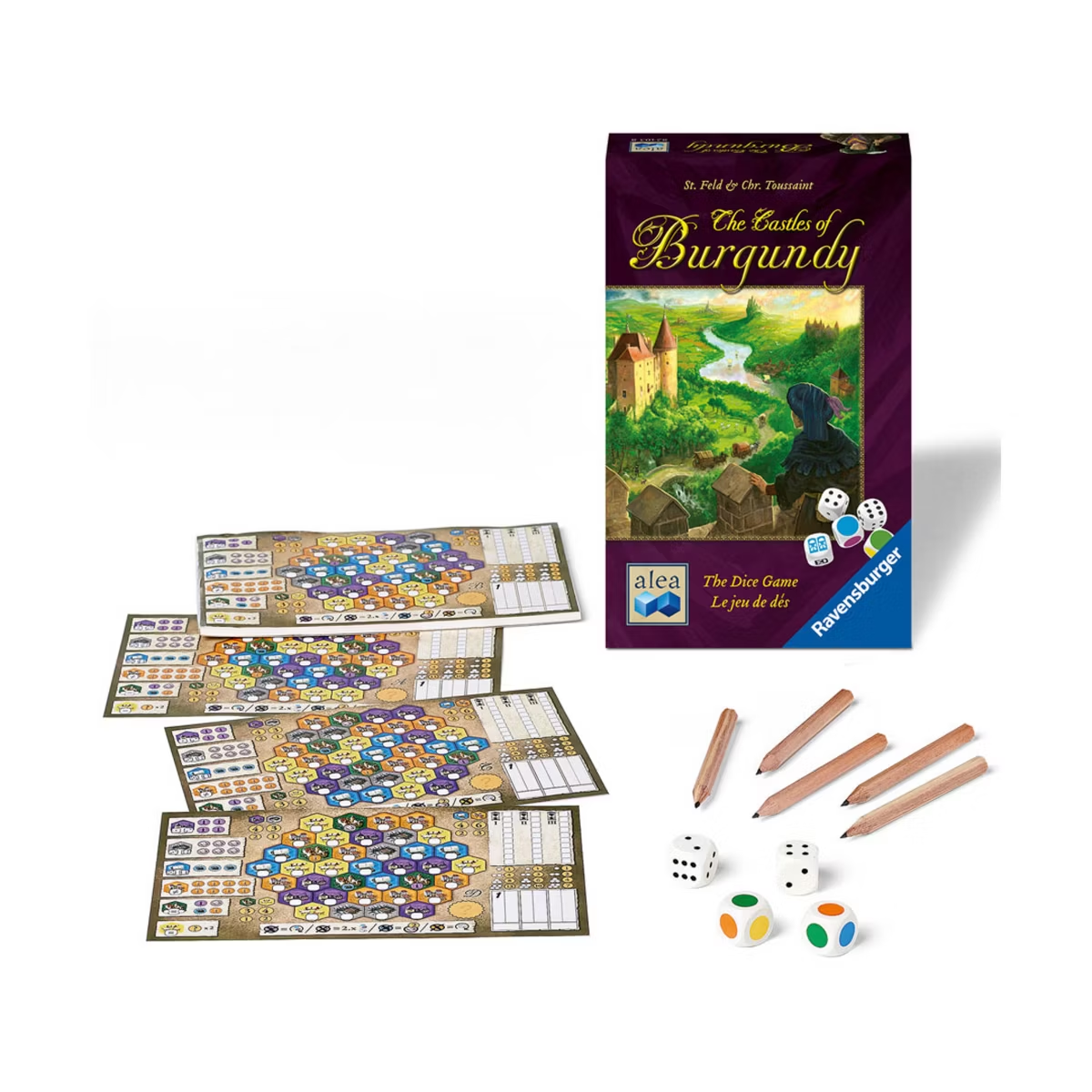
- Iconography and tile symbols can be hard to read at first
- Setup and tile management can be a bit fiddly
- Luck in dice rolls may swing outcomes despite planning
- Some player boards feel more favorable by chance
- Interaction is mostly indirect (tile drafting, turn order)
- The game can feel dry due to its abstract presentation
Comparison to Similar Games
Compared to Amun-Re or Tigris & Euphrates, Castles of Burgundy is lighter in conflict yet retains deep spatial puzzles. Whereas Carcassonne focuses on area control and tile adjacency, Burgundy emphasizes dice-based access and optimization. In contrast to Isle of Skye, which uses dynamic pricing, Burgundy’s challenge is in choices under dice constraints and spatial layout. While not as narrative-heavy as Viticulture, it outpaces many light euros in complexity and pure decision density.
Final Thoughts
Castles of Burgundy remains a benchmark eurogame due to its elegant balance of simplicity and depth. Although the theme is understated and presentation sometimes flawed, the core system rewards thoughtful play. For players who enjoy optimizing under constraint and modular variety, it’s a perennial favorite. If instead you prefer strong theming or direct conflict, it may feel too clinical. Yet for those seeking a refined, strategic experience, Castles of Burgundy delivers enduring appeal.
And remember, Frontline Gaming sells gaming products at a discount, every day in their webcart!