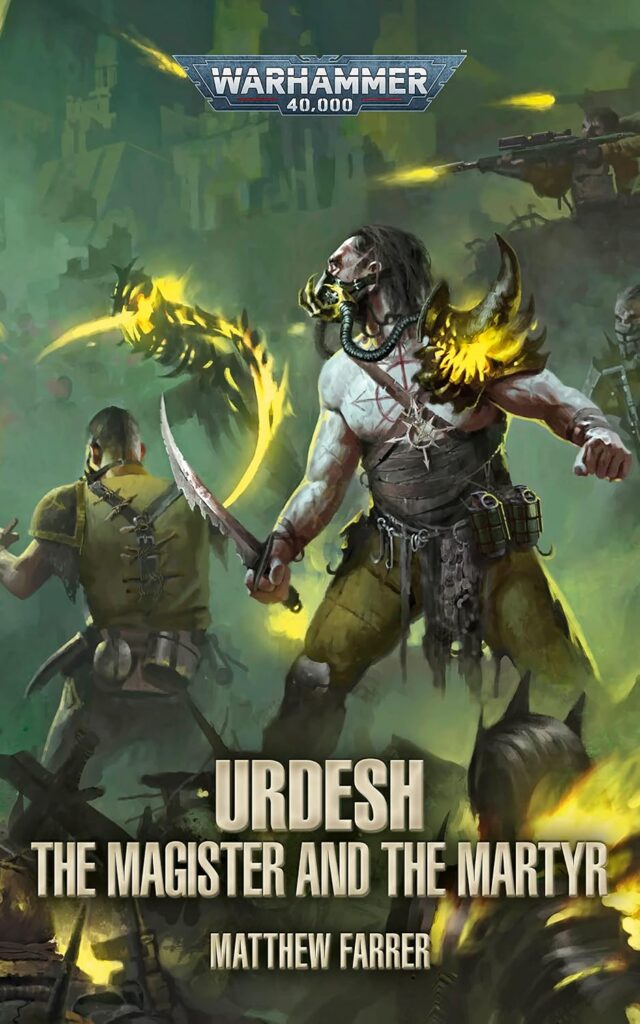
I went into Urdesh: The Magister and the Martyr with steady expectations. It closes Matthew Farrer’s Urdesh duology and keeps the fight on the forge world.
However, it frames the Iron Snakes inside an Astra Militarum-led war by design. Consequently, the view is intimate, procedural, and logistics-forward. Still, readers without wider Sabbat context may feel underbriefed.
Plot
The story resumes immediately after The Serpent and the Saint. Iron Snakes detachments secure routes, escort saintly assets, and break cult networks across Urdesh’s manufactoria. However, operations unfold as linked raids and timed thrusts rather than a single set piece. Consequently, the climax depends on synchronized assaults and hard choices, but also miracle charges. Altogether, the campaign reads coherent, if intentionally restrained. Additionally, the placement sits between The Warmaster and The Anarch, so several outcomes echo into Abnett’s finale.
Characters
Farrer presents the Iron Snakes as disciplined professionals first. Command voices balance Ithakan rite with battlefield pragmatism. However, few Marines lodge as indelibly as Abnett’s Priad cohort. Consequently, many viewpoints convince in scene yet fade afterward. Additionally, allies and mortal auxilia add fear, friction, and doctrinal texture. Still, the saint’s orbit generates tension without erasing the Marines’ agency.
Narrative Feel
The prose favors routes, ranges, and timings over operatic myth. Battles are legible, often quick, and grounded in materiel detail. However, the tone seldom lifts into transcendent Marine legend. Consequently, the book feels like campaign reportage set to bolter tempo. Nevertheless, the industrial piety of Urdesh is consistently realized.
Series Connections
This is book two of the Urdesh series and closes its arc. It runs parallel to the Gaunt’s Ghosts front at Urdesh and slots between Abnett’s late-Crusade novels. Consequently, several beats land harder if you have read the surrounding titles. Therefore, newcomers may miss context that the narrative assumes. Still, Crusade veterans will recognize cross-currents and shared stakes across the theatre.
Summary and Verdict
On its own terms, the novel is clear, grounded, and tactically credible. It provides a deliberate view of Astartes operating inside a larger machine. However, it does not match the mythic bite of Brothers of the Snake. Consequently, character impact trails the excellent mapwork and logistics clarity. Even so, Sabbat devotees will appreciate the connective tissue and theatre coherence. Therefore, I recommend it to Crusade readers seeking methodical campaign fiction. Newcomers should expect to consult other Sabbat titles for the full effect.
And remember, Frontline Gaming sells gaming products at a discount, every day in their webcart!