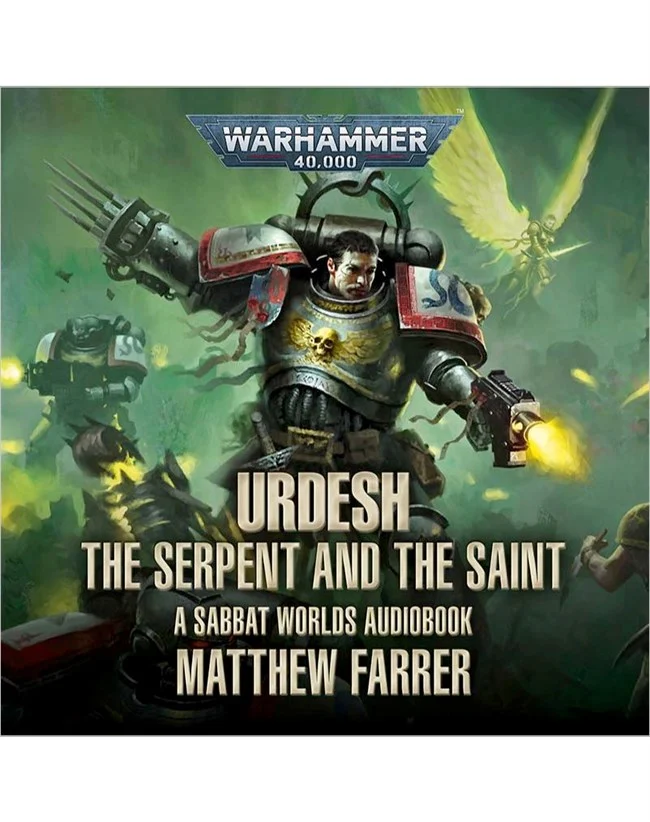
In this novel Matthew Farrer aims for a hard-edged campaign novel set on a crucial forge world.
The book delivers smoky industry, measured tactics, and plenty of bolter grit. However, it does not quite match the mythic clarity of the Iron Snakes’ earlier showcase. Even so, it remains a credible, Crusade-era snapshot of desperate Imperial warfighting.
Plot
The story follows Iron Snakes formations fighting to keep Urdesh out of the Anarch’s bloody grasp. Moreover, the Marines must shield the reborn Saint and her entourage while crusade cohorts attempt to keep the campaign alive. Farrer frames the war as raids, corridor pushes, armour thrusts, and attrition-ridden holding actions. Consequently, the narrative prizes logistics, fire lanes, and timing over miracle charges. Meanwhile, Chaos commanders and entrenched cult networks complicate every turn of the wheel. Therefore the endgame hinges on converging strikes and saintly symbolism rather than spectacle alone. The result feels like a deliberate theatre campaign instead of a single set-piece.
Characters
Farrer writes the Snakes as professional, Ithakan, and ritual-bound without melodrama. Moreover, squad and command viewpoints emphasize discipline, economy, and duty over quips. Mortal auxiliaries add ground-level fear, which sharpens the Astartes’ otherness. Additionally, the Mechanicus voices provide doctrinal friction and cool arithmetic. However, few characters cut as sharply as Priad and company in the earlier Iron Snakes novel. Consequently, the cast persuades, yet it rarely lodges in memory after the smoke clears.
Narrative Feel
The prose is clean, tactical, and grounded in materiel reality. Furthermore, Farrer stages battles with legible routes, ranges, and objectives. Atmosphere skews industrial and pious rather than operatic or baroque. Therefore the book feels authentically Sabbat: oily, reverent, and exhausted. Nevertheless, long action passages can read procedural where some readers want transcendence. Even so, the battlefield clarity and manufactorum texture remain consistent strengths.
Series Connections
Urdesh sits inside the broader Gaunt’s Ghosts phase that assaults the forge world. Moreover, Farrer’s novel was designed to interlock with Dan Abnett’s front, covering parallel angles of the same offensive. The stakes tie directly to the Anarch’s machinations and the Crusade’s future momentum. Additionally, the book seeds into a two-part sequence continued in The Magister and the Martyr. Therefore returning readers will spot cross-currents with The Warmaster and Anarch, while newcomers still follow the theatre. These links make Urdesh feel like a deliberate node in a planned metaplot.
Summary and Verdict
Urdesh: The Serpent and the Saint is a solid Sabbat-era war novel with clear stakes. Moreover, it respects campaign logic and the machine-faith that powers a forge world. However, it does not reach the personality and mythic punch of Brothers of the Snake. Consequently, character impressions fade faster than the battle maps and order of battle. Even so, the book offers dependable action, credible logistics, and welcome Crusade connective tissue. If you want the grind of a real theatre and the sense of a coordinated narrative, Urdesh delivers on both counts.
And remember, Frontline Gaming sells gaming products at a discount, every day in their webcart!