
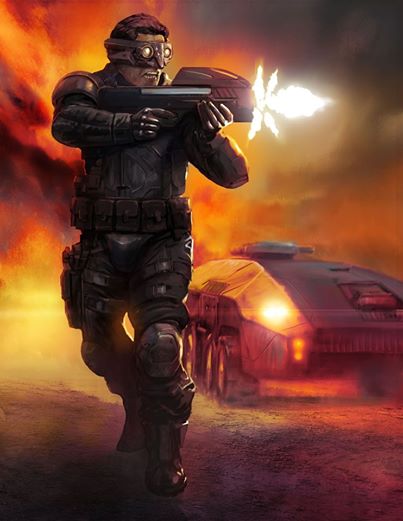
Cameron visits Frontline Gaming while home for the holidays. He normally plays out in Atlanta. He takes out his PHR vs. Reecius’ UCM in this 1500pt battle on the new official DzC F.A.T. Mat which we call: Urban Zone! As always, check out the Tactics Corner for more great video bat reps!



The miniatures are great its a pity the rules are a poor version of Epic Armageddon.
The rules are actually quite different. The game is less about mass formations and indiscriminate killing and more about tactical maneuver and targeted destruction. I find that DZC conveys a more well thought out and realistic style of warfare, but both forms of war-game are fun in their own ways.
Totally agree.
Actually the rules of this game are its selling point, IMO. They are balanced, fun, and allow for a lot of scaling up in skill. I love the game.
Thanks for the batrep, always good to see more DZC.
I don’t have my rulebook, but I thought you had to be able to place the LZ template in order to land and thus drop off units. The Poseidon incidence is a case where I’d let it go especially since this was a friendly game. I’ll have to search the black and white later to see how it is actually worded.
Yeah, we just ran with it as we were playing for laughs.
Glad you liked the report, it was a really good game.
The turns look like they take for ever with all the “I go, you go” activations
Not at all, DzC is faster than 40k. It just feels that way because of all the cut scenes in a video bat rep.
Players end up being more engaged, overall. An “I go” turn will typically take less than a minute without shooting, or maybe 5 minutes with shooting if the battle group is big. A battle group is typically between 1 and 10 models. Much faster feel and no chance of a BS alpha strike in the first turn, either.
If you are near Frontline on Sunday, Reece and I will be playing. Not sure the time yet. Probably early.
Agreed 100%. I have always enjoyed alternate unit activation games more for the reasons you listed.
I find it hard to find a good time to take a bathroom break in a game of DZC b/c I am constantly engaged w/ my opponent over what’s going on. It’s an interesting problem to have.
Yeah, alternate unit activation is so much more enjoyable.
The filming definitely takes forever… but an unfilmed game plays quickly.
Yeah, DzC is far from an Epic clone.
Epic immerses the player in the WW1/WW2 style 40k setting. DzC is definitely set up to portray a very different type of game. Further, it doesn’t steal mechanisms from Epic.
Alternating activation makes the missions faster, even if it makes the videos a little faster. You’ll find there’s actually more detail in a DzC report in total. Because you aren’t trying to talk about the entire turn in one go. It’s just summarising the actions of two or three squads each time.
In this particular mission we have found there is a better way to handle the objectives. Have a bag with the markers where 5 are different in colour. Then you can have anything you want on the table so even if they gets flipped because of a mistake or whatever it doesn’t matter because you will just remove the marker from the table and see if it is an objective by drawing
one from the bag. Works like a charm.
We had pretty much the same impression regarding the mission in itself. That one player can have all objective close to them but I think the statistical chance for a very uneven game is pretty low. Whenever we tested this mission (with the mindset that it will be very uneven) it has actually worked very well.
That’s a good suggestion with the colored markers, we may implement that one ourselves. The odds are low that you get a totally lopsided game, but if it does happen during a tournament, that really stinks as it can ruin the experience for one of the players. I like to ensure that competitive matches are as close to even as possible. For narrative/campaign games though, imbalance can be a lot of fun.
Drawing from the bag also means that if you grab objectives earlier, they are statistically less likely to be worth points.
Which means that it puts pressure on you not just to blow through buildings as fast as you can.
I kind of like that idea!
Though it does alter the mission slightly, my buddy and I found a decent work around to the potential lopsided objectives problem. We made four piles, one for each table quarters, and put an objective in each pile. We then added the fifth object to the large non objective pile, which then also got divided equally amongst the four table quarters. Not sure if I’m explaining it well, but essentially every table quarter gets an objective and one quarter (random) will have two. It makes it very interesting. I found an objective early in one of my quarters so I figured statistically I should move on to another quarter. Fifth objective ended up being right next to the one if already found.
Yeah, totally makes sense, and we agree. It’s more fun if it’s even.